


What are AI Agents

What are AI Agents

Agentic AI systems pursue goals, take sequences of actions, and adapt to changing inputs without step-by-step instructions. Unlike chatbots, they automate end-to-end business processes across departments, data sources, and approval chains. Organizations that deploy agentic AI correctly eliminate the manual handoffs that slow operations and expose processes to error.

In a commercial setting, they automate repetitive processes, analyze data in real time, and integrate with business systems like Microsoft 365, SharePoint, or CRM platforms. Unlike traditional automation, agents adapt to changing inputs and handle exceptions on their own.

Agents specialize in distinct roles such as customer support, procurement, product design, or factory operations, each running independently while contributing to broader business goals. By dividing complex workflows into focused responsibilities, they enable faster execution and reduce human error.

Whether assembled with low-code tools or advanced frameworks like Microsoft Foundry, AI Agents let your teams handle more work without adding headcount.
How do Agents Work

How do Agents Work

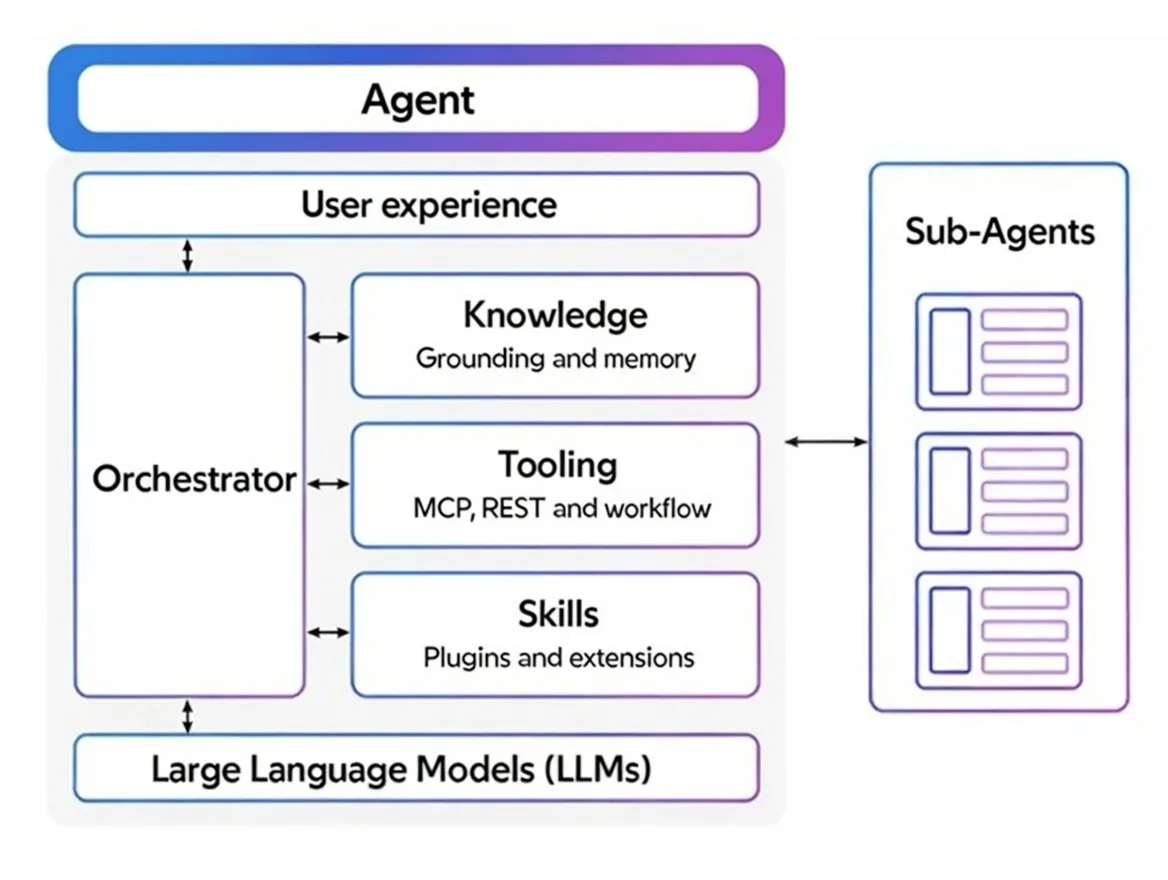
Every production AI agent is built on three pillars: Knowledge is the data it reasons over, Tools are the capabilities it can invoke, and Skills are the domain expertise it applies: areas like marketing, legal, or finance. This structure, at the core of modern agent design, determines how reliably an agent performs in your business.

Work IQ serves as the gateway to Microsoft 365 data, surfacing documents, conversations, and operational context from SharePoint, Teams, and e-mail. Foundry IQ complements this by partitioning that data and scoping each agent to exactly the information it needs.

Existing REST APIs slot directly into the tools layer, consumed as-is or wrapped in MCP (Model Context Protocol). MCP turns point-to-point integrations into reusable capabilities any agent can call, without rebuilding your infrastructure.

Whether it’s a CRM endpoint, a document store, or an approval workflow, MCP connects it to your agents without rebuilding what you already own.

Multi-Agent & Autonomous

Multi-Agent & Autonomous

When a task is too complex for a single agent, multi-agent systems divide the work across specialized agents that each own a distinct responsibility. Every agent contributes its part while sharing context with the rest of the team, allowing complex business processes to complete without human coordination at every step.

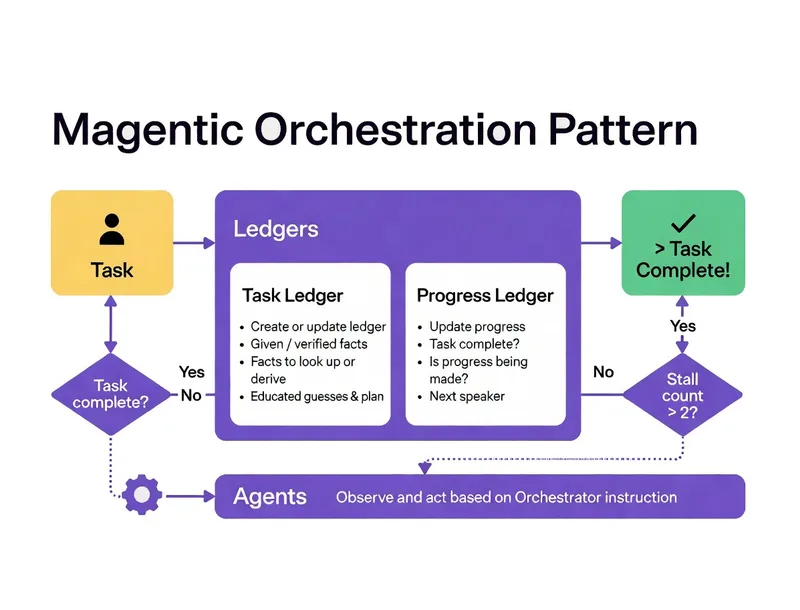
Microsoft Agent Framework provides the orchestration layer that ties agents together. The Magentic Orchestration pattern uses a shared ledger to track what has been done, what is in progress, and what still needs to happen, giving every agent a consistent view of the task at all times.

Autonomous agents take this further by operating independently across extended workflows. They perceive their environment, make decisions, and take action without being prompted at each step, pursuing the goal until the task is fully complete.

The result is a self-coordinating agent team that completes complex, multi-step operations faster and with full traceability, turning processes that once required constant oversight into reliable, hands-free workflows.

70%
repetitive tasks automatable (McKinsey, 2023)
faster process execution (Integrations IT Solutions client data)
24/7
unattended, no human loop
< 30 days
pilot to production agent (Integrations IT Solutions client data)
Vision to Value: The Agentic AI Path
Envision & Plan 2 steps
01
Find the Processes That Drain Your Business Most
You leave with a ranked roadmap tied to real business KPIs — not a generic AI strategy that collects dust. Value Discovery workshops map your operations, score each process by ROI and implementation complexity, and surface the opportunities your competitors haven't automated yet. Most organizations know they want AI but not where to start. This step produces the clarity that makes every subsequent step faster.
02
Map Processes to KPIs and Build Your Implementation Plan
Quick wins are sequenced first, giving your organization early proof points before tackling more complex or cross-departmental workflows. Each candidate process is mapped to the KPIs it moves — revenue, cost, cycle time, error rate, or customer satisfaction — and prioritized by automation ease and operational disruption. The output is a phased implementation plan with low integration complexity and high-repetition processes at the front.
Implement 4 steps
03
Match the Right Tool to Every Task, from Low-Code to Pro-Code
Not every process needs a full engineering team, and not every use case fits a low-code tool. Copilot Studio and Claude Cowork let business users build department-level agents that handle approvals, reporting, and document workflows without writing code. For complex multi-agent systems, Microsoft Foundry and Agent Framework give engineering teams full control over orchestration and evaluation. Most organizations run both. Every low-code agent is designed with a clear path to a full engineering build when the use case outgrows it.
04
Research and Wire Up the Capabilities Your Agents Actually Need
Agents without the right capabilities produce generic outputs your teams won't trust. Knowledge grounding starts by connecting agents to SharePoint, CRM, ERP, and internal documents so they reason over your actual business data. Tools let agents take action by triggering approvals, updating records, and running reports. Existing REST APIs slot in directly or get wrapped as MCP servers, making every business capability reachable by any agent without rebuilding your infrastructure.
05
Surface Agents Wherever Your People Actually Work
Agents only create value if your people actually use them. For many processes, surfacing agents inside Microsoft 365 works best because employees already spend their day in Teams, Outlook, and the Copilot UI. For other tasks, desktop automation with Claude Cowork is the simpler and faster path. Each surface is matched to the workflow so your teams interact with automation in the way that feels most natural to them.
06
Apply Enterprise Engineering Discipline, Regardless of Organization Size
Even small agent deployments benefit from the disciplines that keep enterprise systems reliable over time. Every project is set up on GitHub with version control, automated testing, and CI/CD pipelines from day one. Evaluations run on every model update or grounding source change so nothing degrades silently. Infrastructure as Code makes every environment repeatable and disposable, so you can spin up a fresh test environment or recover from a mistake in minutes instead of days.
Operate 2 steps
07
Assign Clear Responsibility for Every Data Source Your Agents Rely On
Agents degrade silently when nobody owns the knowledge they reason over. Clear responsibility chains are established for every grounding source so that data stays accurate, permissions remain current, and stale information gets refreshed before it reaches users. Each data source has a named owner, a refresh cadence, and a fallback path. Your agents stay reliable because the information they depend on is actively maintained, not left to drift.
08
Gain Full Observability and Compliance Across Every Agent Interaction
Running agents without observability means you discover problems from your users, not your dashboards. Every agent is instrumented with monitoring that tracks task success rates, latency, token consumption, and grounding quality. Microsoft Purview enforces data classification and access policies across all agent interactions, so your compliance team sees exactly what data agents touch and your board gets the audit trail it needs without manual effort.
Educate & Evolve 1 steps
09
Educate Your Teams and Re-Evaluate What Is Actually Working
Technology launches that skip change management fail. Consistently and expensively. Role mapping, change management plans, and targeted training ensure every employee understands how agents augment their specific role. Hands-on workshops complement this by building real AI competency so your teams can extend, adapt, and improve their agents independently. At regular intervals, every agent is re-evaluated against the original KPIs. The ones that stopped delivering get retired or reworked, keeping your agent estate lean and effective.